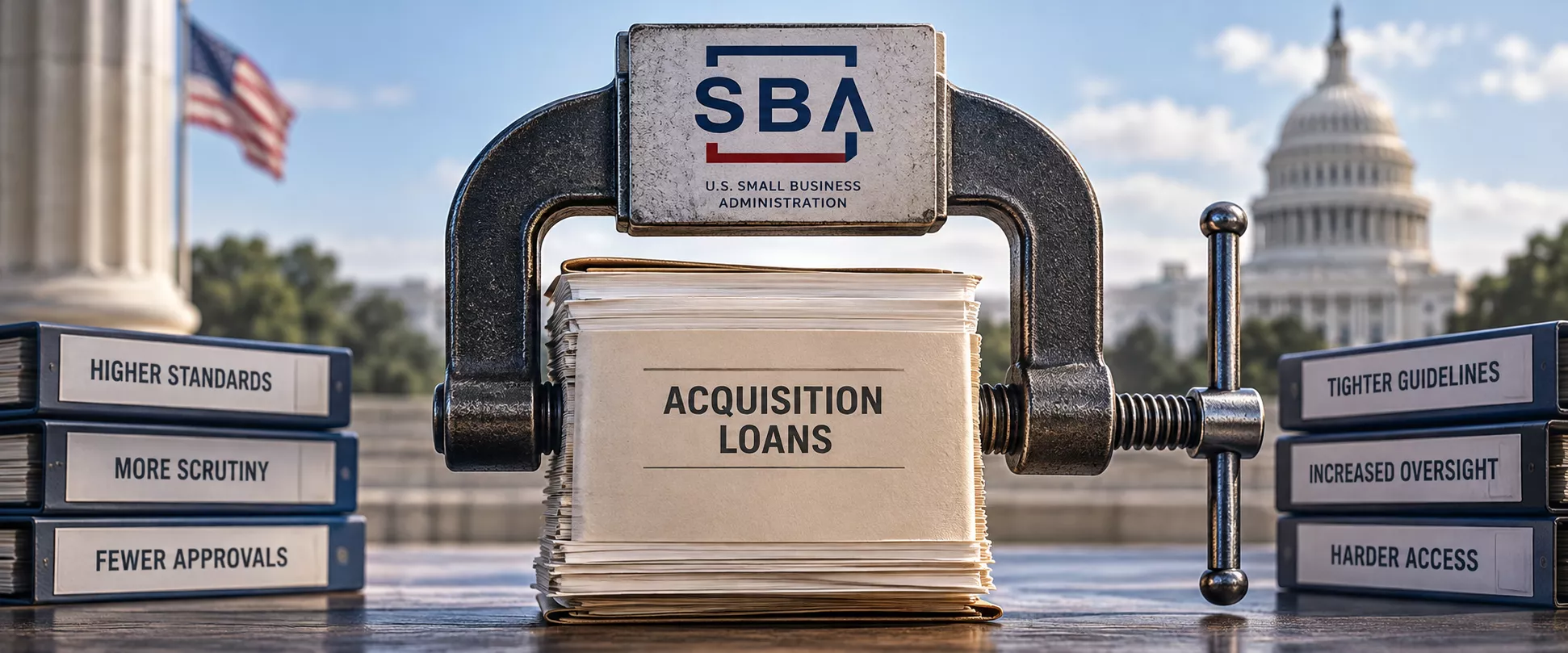
American Banker reported on October 9 that the Small Business Administration opened fiscal 2027 with a tighter credit box than the one it closed fiscal 2026 with. If you plan to buy a company in the next year, the rules you researched over the summer won’t be the rules you will be underwritten against.
What are the new SBA business acquisition loan requirements
Four changes, effective with the start of the new fiscal year in early October:
A quality of earnings report. Borrowers seeking more than $3 million to buy a company must now provide a CPA’s assessment of the target’s earnings. That is a real engagement with a real invoice, and it happens before you know whether the loan is approved.
Trailing earnings, not projections. Underwriting has to rest on what the target actually earned, not on what it is forecast to earn. Any deal whose math depends on growth you intend to create is materially harder to finance.
Stricter debt-service requirements. Less headroom on the coverage test.
A limit on how you fund the equity injection. The 10 percent injection remains, reinstated back in June 2025 for startups and ownership changes. What is new is that non-cash sources can cover no more than half. Seller notes and similar structures do less work than they used to.
The SBA also barred noncitizen lawful permanent residents from obtaining SBA loans. Lenders quoted in the article called that one counterproductive.
How much did lending actually fall?
In fiscal 2026, the 7(a) program approved 56,130 loans worth $32.4 billion, double-digit declines in both count and dollars. The 504 program fell 9 percent to $7.1 billion. Live Oak, the largest 7(a) lender, fell 9 percent to roughly $2.6 billion, and most other top-ten lenders declined too.
Some of that is an artifact. A Lumos Group study found the government shutdown in late 2025 pulled loans forward into the prior fiscal year. But the direction is consistent, and Eric Rabinovich of SBA Loan Lab put it plainly: “I think objectively it became harder to get deals done.” He also says demand has not dropped.
Ben Johnston of Kapitus offered the other view — that the agency needed to correct back toward its historic profitability. Both things can be true. A program that lends more loosely eventually lends less.
What this means if you are buying
Budget for diligence you did not expect to pay for. Above $3 million, the CPA report is now a cost of entry, not a nice-to-have. Get a lender’s read on your structure before you commission it.
Bring more real cash. Half the injection has to be cash, which raises the floor for first-time buyers specifically. If you were assembling the equity out of seller paper and goodwill, rebuild the stack now rather than at underwriting.
Buy earnings, not a story. The rule change is Washington telling you what it thinks of acquisition models built on projected synergies. If the business does not service the debt on last year’s numbers, this deal is not financeable this year, whatever the spreadsheet says.
Start the lender conversation earlier than you think you need to. Terms are moving. The one you were quoted in August may not survive to closing.
The wider read
Acquisition is one of two doors into ownership, and that door narrowed this month. The other one did not.
Starting from nothing is slower, and it isn’t free, but it doesn’t require a CPA’s blessing of somebody else’s books or a cash injection you have to raise before anyone will look at you. For anyone reconsidering the route, A2Z Business Consulting offers a straightforward walkthrough of how to start a business, from entity setup through marketing.
I have done both. I’ve bought companies and built them from a desk and a phone. Neither is the easy one. They are just hard in different ways, and this month the cost shifted to the buying side.
If you are weighing the two and want someone who’s made both calls to pressure-test the numbers with you, that is where I can help.