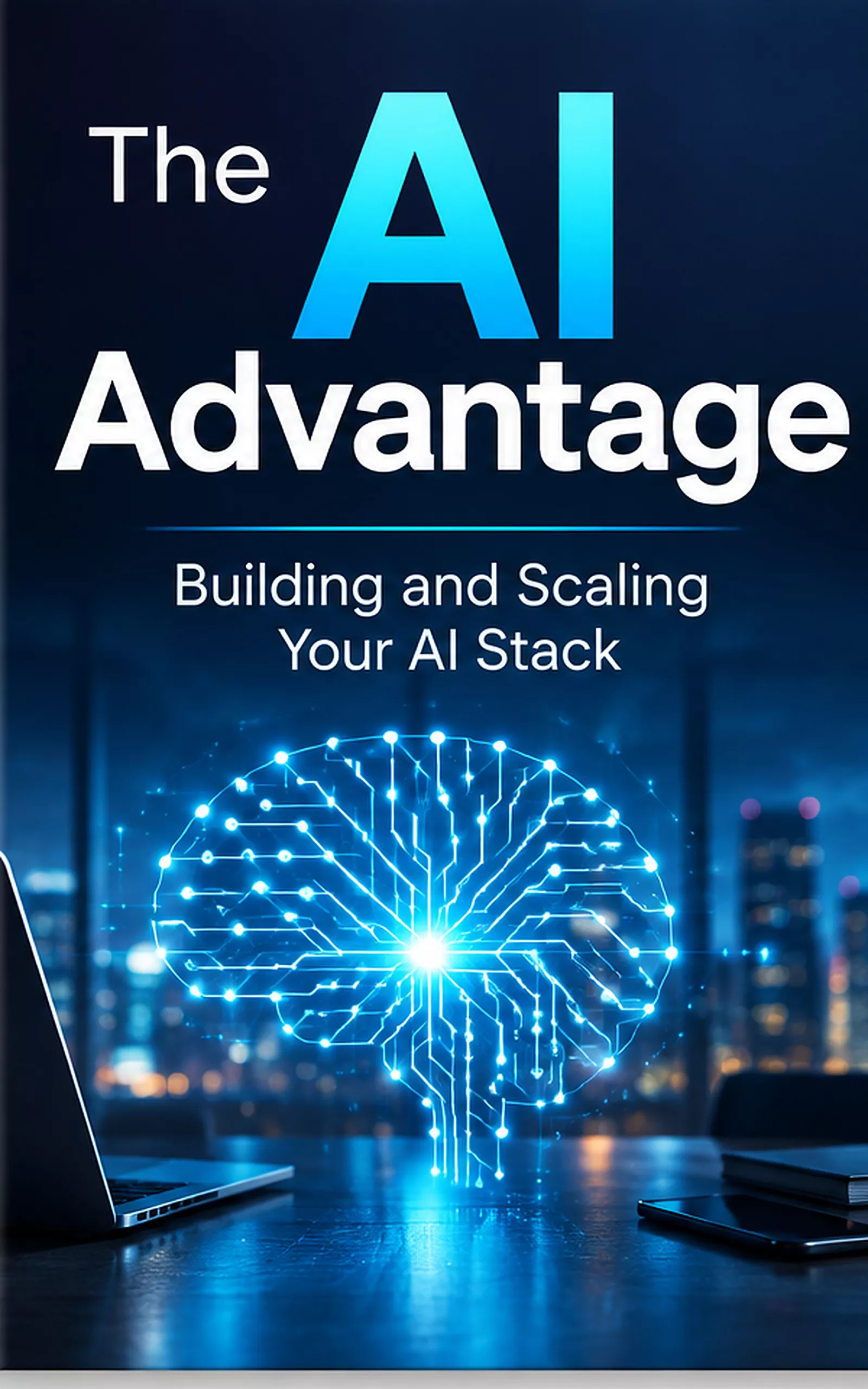
The AI Advantage
Building and Scaling Your AI Stack
- Author
- Bruce T. Dugan
- Published
- 2026
- Length
- 66 pages
- Format
- Kindle edition
- Publisher
- I2 Publishing
The AI Advantage: Building and Scaling Your AI Stack
You have two or three AI tools working in your office. You are also standing in the middle of them, manually copying text, images, or data from one browser tab to the next.
That is not an AI stack. That is you, performing software integration by hand.
Single-tool productivity has officially hit its ceiling. The next major leap in efficiency does not come from finding a slightly better model—it comes from stacking multiple specialized tools together so each executes what it is genuinely good at, and wiring the automated handoffs so your pipelines run without constant human shepherding.
The AI Advantage—Book Two in the AI for Business Owners series—is an advanced implementation playbook. It assumes you are past the initial question of whether artificial intelligence is useful, and are ready to tackle the harder challenge: how to build an AI stack that continues to work when you stop watching it.
Structure Before Scale
AI is an amplifier of operational reality. If your workflow is disorganized, introducing automation will only generate automated chaos at scale. Before scaling, you must build your stack around clear strategic pillars:
| Stack Pillar | Core Objective | Key Execution Areas |
|---|---|---|
| Multi-Model Stacking | Routing tasks to the specific model best suited for the job rather than relying on one general system. | Knowing where OpenAI, Claude and Gemini each excel—and where each one stops—so every task lands on the right model. |
| Unattended Pipelines | Connecting tools to automate data processing, report generation, and multi-channel content curation. | Utilizing integration layers like Zapier alongside your central CRM to trigger automatic tasks. |
| Governance & Oversight | Implementing essential protocols to manage system drift, rule changes, and hallucination risks. | Designing human-in-the-loop checkpoints so employees validate critical outputs before delivery. |
What the Book Covers
The book runs seventeen chapters. The first five lay the foundations; from Chapter 6 on, it is a stack-building playbook, taking you from systems architecture to scaling AI across an entire organization:
| Chapter | Focus | What You Will Master |
|---|---|---|
| 6 | Designing Your AI Stack | Distinguishing basic automation from intelligent task delegation, and mapping where AI fits into your back-office versus client-facing operations. |
| 6 | Connecting the Pieces | Using integration platforms as functional bridges, evaluating AI app builders, and weighing the honest trade-offs of renting software versus owning code. |
| 7–8 | Implementing and Scaling Workflows | Moving your pipelines from simple tests to resilient systems that survive day-to-day organizational demands. |
| 9 | Measuring Real ROI | The operational discipline to audit your AI programs honestly, track saved hours, and decommission integrations that fail to deliver. |
| 10 | Risk and Governance | Establishing rules, validation procedures, and protocols that protect your operational integrity against drift and hallucinations. |
| 11 | Evaluating Platforms | Understanding where major AI systems reach their limits, which is far more useful than cataloging what they promise to do. |
| 13 | The Nine-Step Roadmap | A structured guide to assessing needs, piloting small projects, selecting platforms, integrating systems, establishing oversight, training staff, and scaling iteratively. |
| 14 | Case Studies | Walkthroughs of AI stack implementations at four organizational sizes—from solopreneurs to large enterprises. |
| 15–16 | The Human Element | Preparing your workforce for structural shifts, managing evolving responsibilities, and ensuring employees view AI as an empowering partner. |
Quick Answers
What is an AI stack?
An AI stack is the set of AI models, integration tools and business systems you connect so work moves between them automatically. A typical business AI stack pairs two or more language models with an integration layer such as Zapier and a central CRM, with human checkpoints where output matters.
How do you build an AI stack for a business?
Start with structure, not tools: map the workflow, pilot one small project, then select the platforms that fit it, connect them, and add governance before you scale. The AI Advantage lays this out as a nine-step roadmap, from assessing your needs to scaling iteratively.
Does an AI stack still need human oversight?
Yes. AI can drift, hallucinate, or misread an instruction. The stacks that hold up are the ones where people validate critical output and steer the system back on track—oversight is a design requirement, not a precaution.
Link Your Stack Together
If you are at the beginning of your AI journey, start with the first book in this series, AI Today: Where to Start with AI in Your Business, to locate your primary operational bottlenecks.
Once your workflows are defined, let The AI Advantage serve as your blueprint to connect, secure, and scale the AI stack your business runs on.