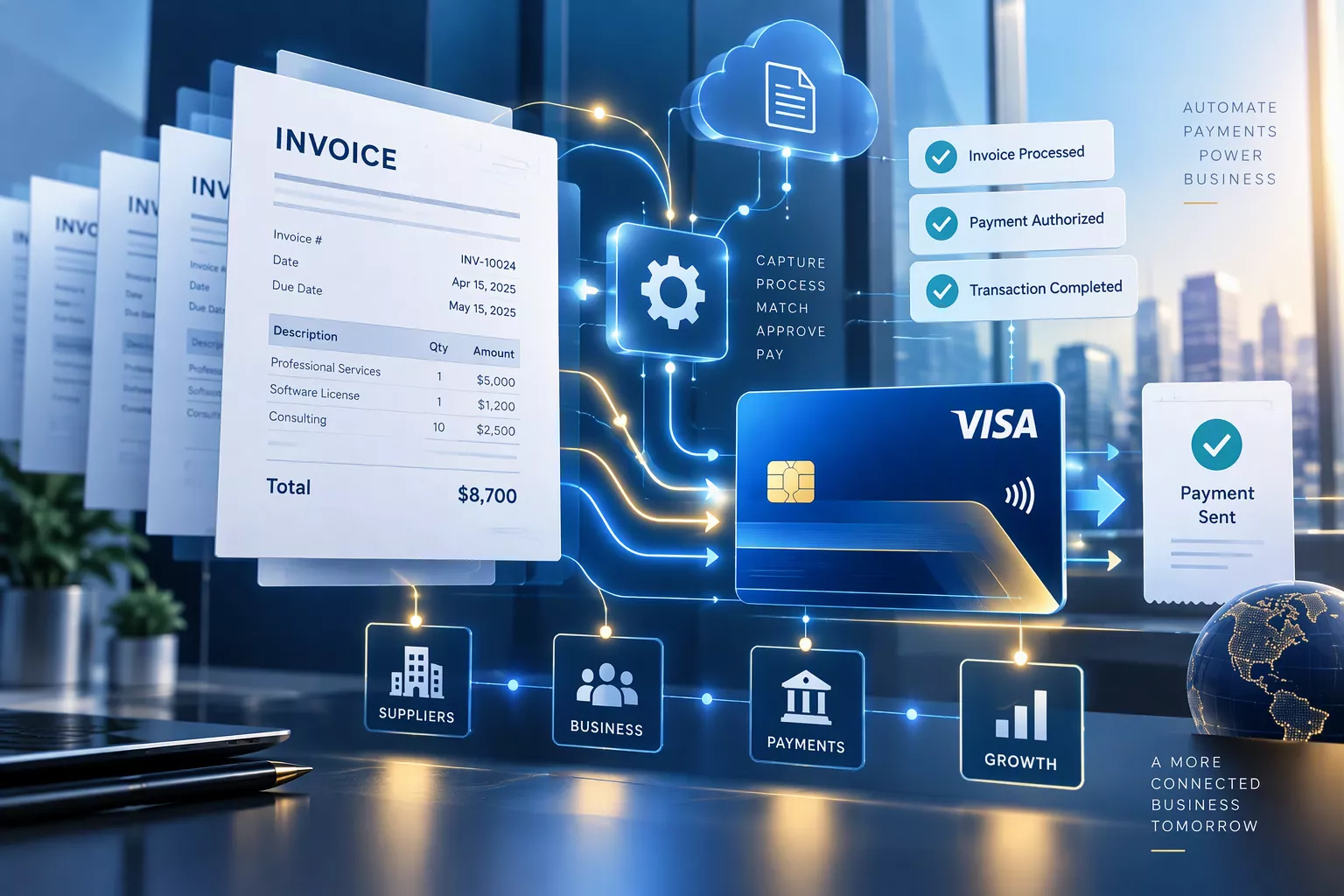
PYMNTS reported on October 20 that Visa has launched an agentic payments pilot with BILL and Billtrust. The report describes it as the first live pilot that lets AI agents pay approved buyer invoices through supplier portals.
Read that slowly, because the boring words are doing the work. Approved. Invoice. Supplier portals.
What is being piloted?
On the buyer side, an authorized BILL Payment Agent, registered through Visa’s Trusted Agent Protocol and Agentic Directory, uses tokenized payment credentials to issue payments on behalf of BILL’s customers, following the buyer’s approved payment instructions.
On the supplier side, Billtrust uses the same protocol to recognize and authenticate that agent when a payment starts, then lets it complete the invoice payment. PYMNTS notes this can replace CAPTCHA and bot-blocking checks without the agent needing a separate login.
Mark Nelsen, Visa’s senior vice president and head of product for commercial and money movement solutions, is quoted saying the pilot tests “how identity, payment controls and transaction visibility” can make that model work.
What the report does not give: scale, results, timing, or whether small businesses are in scope. It refers to BILL’s customers, Billtrust’s customers, and businesses generally. So this is a pilot, not a product you can buy next month.
Why it matters anyway
Because the hard part was never the payment. It was the portal.
If you pay suppliers, you know this work. Somebody on your team logs into eleven different supplier portals, finds the invoice, keys in the payment, clears a CAPTCHA, and does it again. Those portals were deliberately built to require a human. That requirement is exactly what kept the last mile manual.
What Visa is testing is a way for a supplier to verify that the entity logging in is an authorized agent of a known buyer, not a bot. If that works, the portal stops being a wall. And the most tedious recurring back-office task becomes automatable for the first time.
What should you decide before this reaches you?
The word “approved” carries the entire system. An agent that pays invoices according to your approved instructions is fine. An agent that decides which invoices are approved is a different animal, and the distance between those two is one configuration change.
So decide, in writing, before anything like this touches your accounts: what is the largest amount that may leave your business without a person looking at it? Which suppliers are on the approved list and who adds to it? What happens when an invoice arrives that is 40 percent larger than last month’s? Does it pay, or does it stop and wait for a human?
Those are not technical questions. They are control questions, and they are the same ones you should already have answered for your bookkeeper. Most small businesses have not written them down, which works fine while a person who knows your business is making the judgment call, and stops working the moment that judgment is delegated to software that is optimizing for task completion.
Invoice payment automation is genuinely good news for anyone running a payables process on evenings and weekends. It just arrives in the wrong order. The tooling shows up first, and the governance shows up after something goes wrong. Reverse that, and you get the hours back without the surprise.
Getting operations and payment flows set up so they can take automation is practical work, and ops streamlining is where it lives. Deciding where human judgment stays non-negotiable is a different conversation, and usually a founder-level one. That is the ground executive advisory covers.