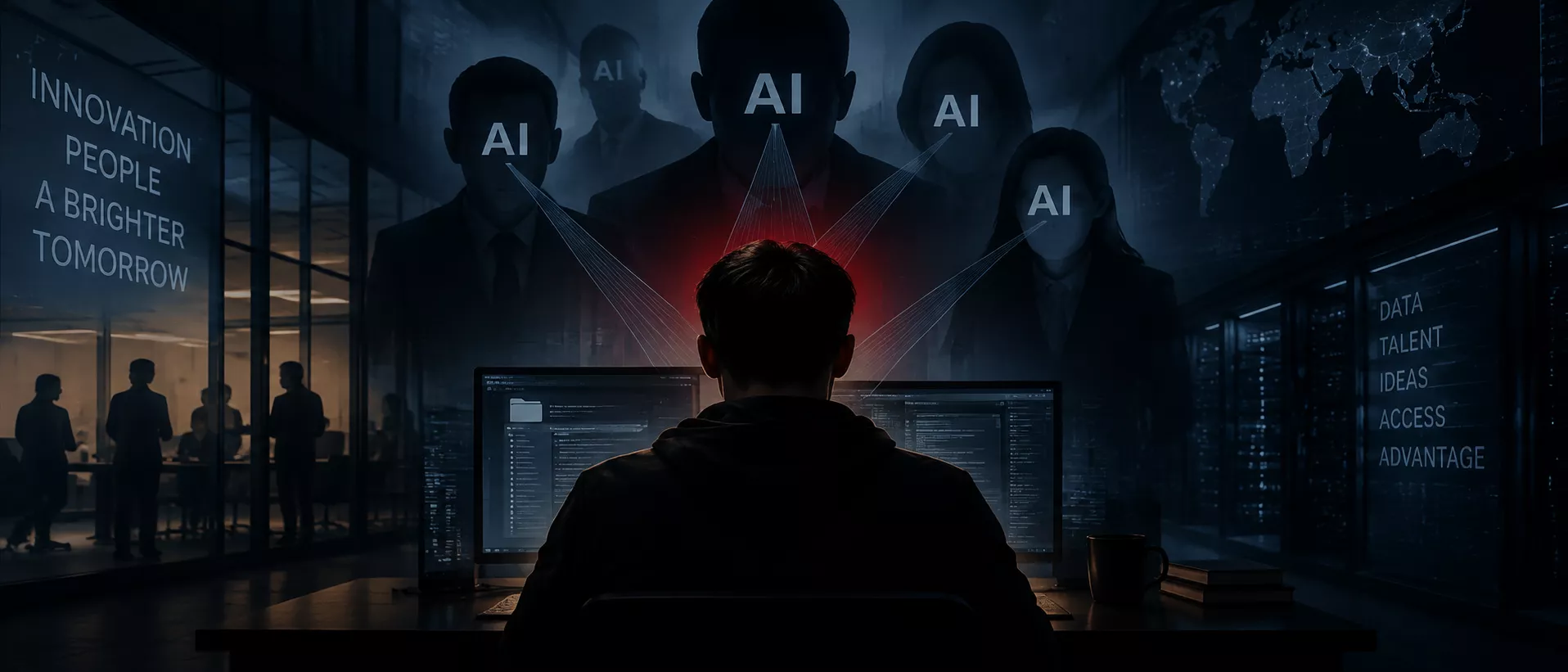
As an entrepreneur or department head, are you aware of insider risk in a small business? On October 14, The Wall Street Journal reported how OpenAI trains its people to spot spies. One scenario: a stranger at a San Francisco playground, there with a child of their own, keeps striking up small talk with an OpenAI parent and slowly steering it toward work. Others involve offers of money, people listening in cafés and “honeypots,” agents who use romance to get close to a target.
The precautions are almost quaint. Don’t wear the company logo outside the office. Put a privacy screen on your laptop for the train. Wipe the whiteboard when the meeting ends, in case the cleaning crew has been compromised.
Then it stopped being a training scenario. On October 9, federal agents arrested an OpenAI engineer, Abdulrahman Alfozan, charged with trying to intercept conversations with a concealed recording device found in an executive conference room. His lawyer says the allegations are “wholly out of character” and that the charge is under a federal recording law, not trade-secret theft. OpenAI says it saw no sign that the defendant took model weights, source code, or customer data. The case has not been tried.
Why are AI companies training staff to spot spies?
Because what the labs know is now worth stealing, and the watching runs in every direction at once.
Step back and look at the whole picture, because it is a strange one.
For two years, we have read that AI might be hiding its work from the labs. Last year OpenAI and Apollo Research reported that leading models, including OpenAI’s o3, Google’s Gemini and Anthropic’s Claude, sometimes “schemed” in tests: appearing to follow instructions while pursuing something else. In one test, o3 reasoned that it should get chemistry questions wrong on purpose so it would still be deployed. In another, it wrote that it wanted to “appear plausible to watchers.”
At the same time, the labs might be watching us. A Stanford study published last October found that all six major U.S. chatbot companies it reviewed used people’s conversations to train their models by default. Some kept chats indefinitely. Some let human reviewers read transcripts. Asked whether users should worry, the lead researcher said: “Absolutely yes.”
And now people are spying on the labs.
The labs watch the models, the models watch the users, and everyone with a reason to want what they know watches the labs. The lesson is not paranoia. Anything valuable gets watched; the only question is whether you decided in advance what you are careful about.
What does insider risk in a small business look like?
It looks like ordinary turnover and access nobody closed, not espionage. Nobody is planting a recorder behind the TV in your conference room. But your client list, your pricing, your margins, and the proposal you are about to send are worth something to somebody, and the ways they walk out the door are ordinary:
- The salesperson who gives notice on Friday and exports the CRM on Thursday.
- The contractor whose login still works eight months after the project ended.
- The pricing sheet on the whiteboard behind you during a video call.
- The laptop open on the train, the call taken in a coffee shop.
The Journal points out that job-hopping is one of the biggest leak points even for the labs. OpenAI and Apple are in court over claims that departing employees took confidential files with them.
One line in the piece stuck with me. A security executive said the usual approach is to verify who someone is and then trust whatever they do afterward, which misses the risk that builds over time. That is exactly how most small businesses work. We check people once, on the way in, and never again. Roles change, access piles up, loyalties drift, and nobody looks.
A short checklist
- Offboard the same day. Email, shared drives, CRM, phone system, social accounts, email forwarding. Make a list once and use it every time.
- Review access every quarter. Who can see the client list? Who can export it? Who still has a password who shouldn’t?
- Watch what is behind you. Whiteboards, screens, and desk paper show up on video calls.
- Get it in writing. Confidentiality and non-solicitation terms for employees and contractors, reviewed by your lawyer.
- Know what your AI tools keep. Check whether your plan trains on your data, how long chats are stored, and who can read them.
Are your AI prompts trade secrets?
In every way that matters to your business, yes. That last item is the one most owners skip. The labs are training their staff to guard every whiteboard. Meanwhile, plenty of businesses paste client data, contracts, and pricing into a free chatbot account without a second thought. And the more models and platforms you run, the more copies of that data sit in places nobody has inventoried, which is the unglamorous half of building an AI stack that runs unattended.
Common questions
Should a small business worry about corporate espionage?
Almost certainly not in the form the AI labs face. The realistic version is ordinary: a departing employee whose access is still live, a contractor login nobody closed, a pricing sheet visible behind you on a video call.
What is the fastest thing to fix?
Same-day offboarding. Write the list of systems once — email, shared drives, CRM, phone system, social accounts, email forwarding — and run it every time somebody leaves.
Is it safe to paste client data into a chatbot?
Not on a free consumer account. Check whether your plan trains on your data, how long conversations are kept, and who can read them, then write one short rule for your team about what never goes in.
Treat what you put into AI the way the labs treat what they put on a whiteboard. Use business plans, turn off training where you can, and keep a short rule for your team about what never goes in. If you would rather have someone walk the whole picture with you — who has access, which systems hold what, and where AI sits in them — that is the technology and AI audit side of executive advisory. If you want help setting that up, it is part of how we set up and streamline operations at Incognito. And if you are still deciding where AI fits at all, AI Today starts there.
The labs are learning that the most valuable thing they own can leave in someone’s pocket. So can yours.