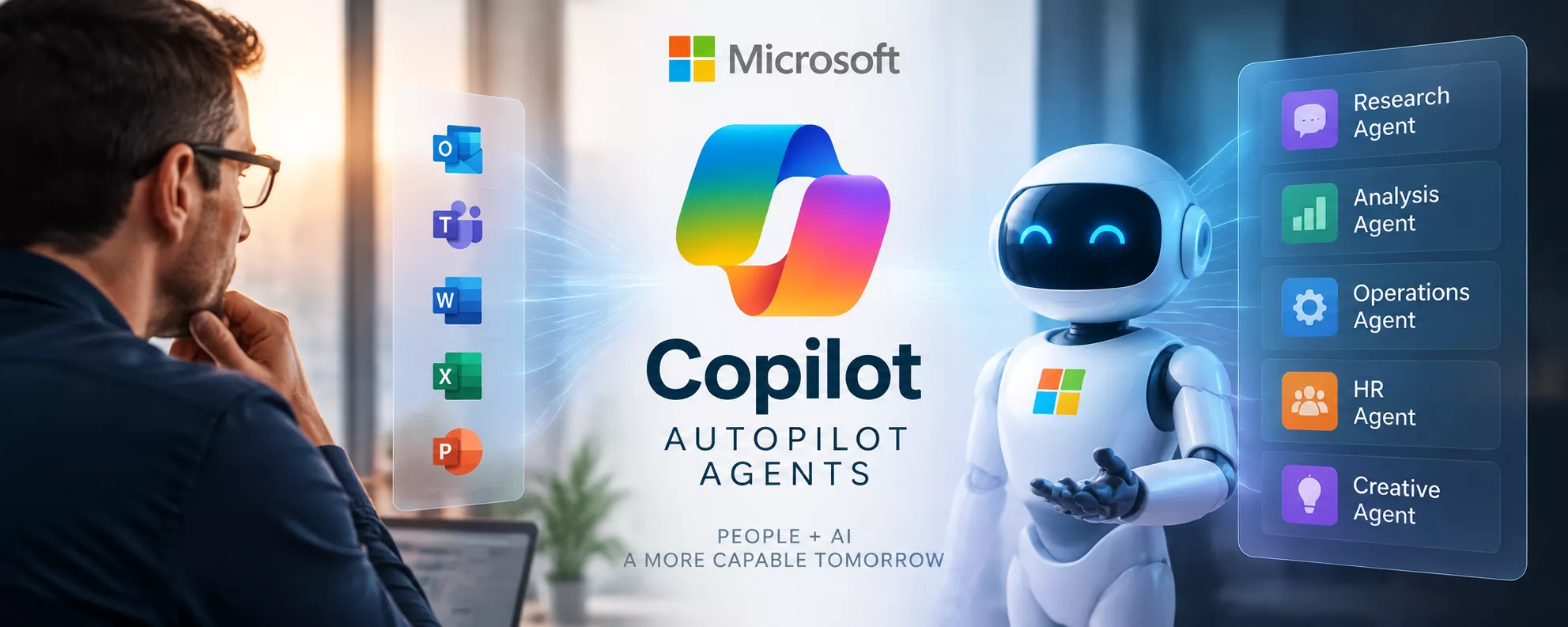
On 25 September Microsoft announced a rebuilt Copilot with three parts: Home, Code and Autopilot. GeekWire’s Todd Bishop reported the key details. Home puts chat alongside Microsoft’s Cowork agent. Code lets you build a tool by describing it. Autopilot creates agents that run on their own in the cloud, inside your Microsoft 365 tenancy, each with its own identity, memory, and email address.
Read that last clause again. Not a chatbot you open. A thing that exists on your staff list, watches the Teams channels and inboxes you point it at, and sends you a note when something looks wrong — a supplier going quiet, a margin slipping, a delivery date that has moved twice.
Microsoft’s own Copilot executive vice president, Jacob Andreou, was refreshingly blunt about the trade. Autonomy and flexibility are what make a long-running agent good, he told GeekWire, and the same qualities make them “absolutely terrifying to an IT admin”. He is right, and the point applies to a six-person firm as much as to a bank. An agent with standing permissions and no supervisor is a staff member you never appraise.
Two things to take from this if you run a small business.
First, the technology has crossed a line that matters commercially. Until now, most AI in a small firm has been attended: you sit down, you ask, you copy the answer somewhere. Attended AI saves minutes. Unattended AI saves shifts. The whole reason to care about an agent with an email address is that it works when you are not working, which is the only kind of leverage a small team has ever been able to buy.
Second, the bill has changed shape. GeekWire reports Microsoft is pricing this on two models at once: the familiar monthly per-user license for the standard features, plus usage-based billing for the heavy agent work and the frontier models. Usage-based billing on something that runs unattended is a combination you want to understand before you switch it on, not after. An agent that quietly does three hundred things a night is an agent that quietly bills for three hundred things a night.
Availability is staged, so nobody needs to rush. Code goes to early-access customers by the end of this month, with a wider release following. Autopilot enters private preview at month’s end. Office integration arrives for consumers and early-access customers shortly. That gives you a quarter to think, which is exactly the right amount of time.
The context is worth knowing as well. Microsoft reported 30 million paid Copilot seats in July, against roughly 450 million commercial Microsoft 365 seats. That is around seven per cent. This announcement is a company with enormous distribution and modest adoption trying to make the thing indispensable rather than optional. You are being marketed to. That does not make the product wrong, but it should slow your hand.
The practical move is unglamorous. Pick one process you already understand end to end. Write down what a competent person would check, in what order, and what they would escalate. Then, and only then, ask whether an agent could hold that list. Automation applied to a process nobody has documented does not produce efficiency. It produces a faster mess.
That sequence — find the hours, describe the work, then stack the tools — is what The AI Advantage is about: putting several models and platforms together into pipelines that run without you standing over them. Microsoft has just made that easier to do and easier to do badly. The difference is entirely in the preparation.